
Advertisement feature — this page is published by Scentech.
Waterless diffuser vs ultrasonic: what actually differs
Nearly every electric diffuser sold in the UK is one of two things, and the shops rarely say which. One kind is a small water tank that turns water into a visible cool mist and carries a few drops of oil along with it. The other holds neat fragrance oil, breaks it into a dry mist with air alone, and never sees water at all. They look similar on a shelf, they cost broadly similar money, and living with them is not similar in the least.
This page is the long version of a paragraph in our comparison of seven diffusers. No laboratory test lies behind any of it; everything below is either a published specification, a dated price or plain arithmetic with the assumption shown.
What an ultrasonic diffuser actually does
Underneath the water sits a small ceramic disc vibrating at a frequency you cannot hear. The vibration throws the surface of the water into a fine cool fog, which a small fan pushes out of the top. Any essential oil floating on that water goes out with it.
The important word is water. John Lewis's own instructions for its Electric Diffuser are to fill the tank with 100 ml of clean water and add two to three drops of essential oil, which tells you the ratio you are actually breathing: overwhelmingly water, faintly oil. Tank sizes on the models we looked at run from 100 ml (John Lewis, Tisserand) to 180 ml (Beurer LA 40). Stated run times run from "up to 45 minutes" in John Lewis's specification table, through Tisserand's four to five hours of continuous mist, to the Beurer's one, three or seven-hour timer.
That is the whole mechanism, and it explains most of what follows: it is cheap to make, it is gentle on the oil, and it puts moisture into the room whether or not you wanted moisture.
What a waterless diffuser does
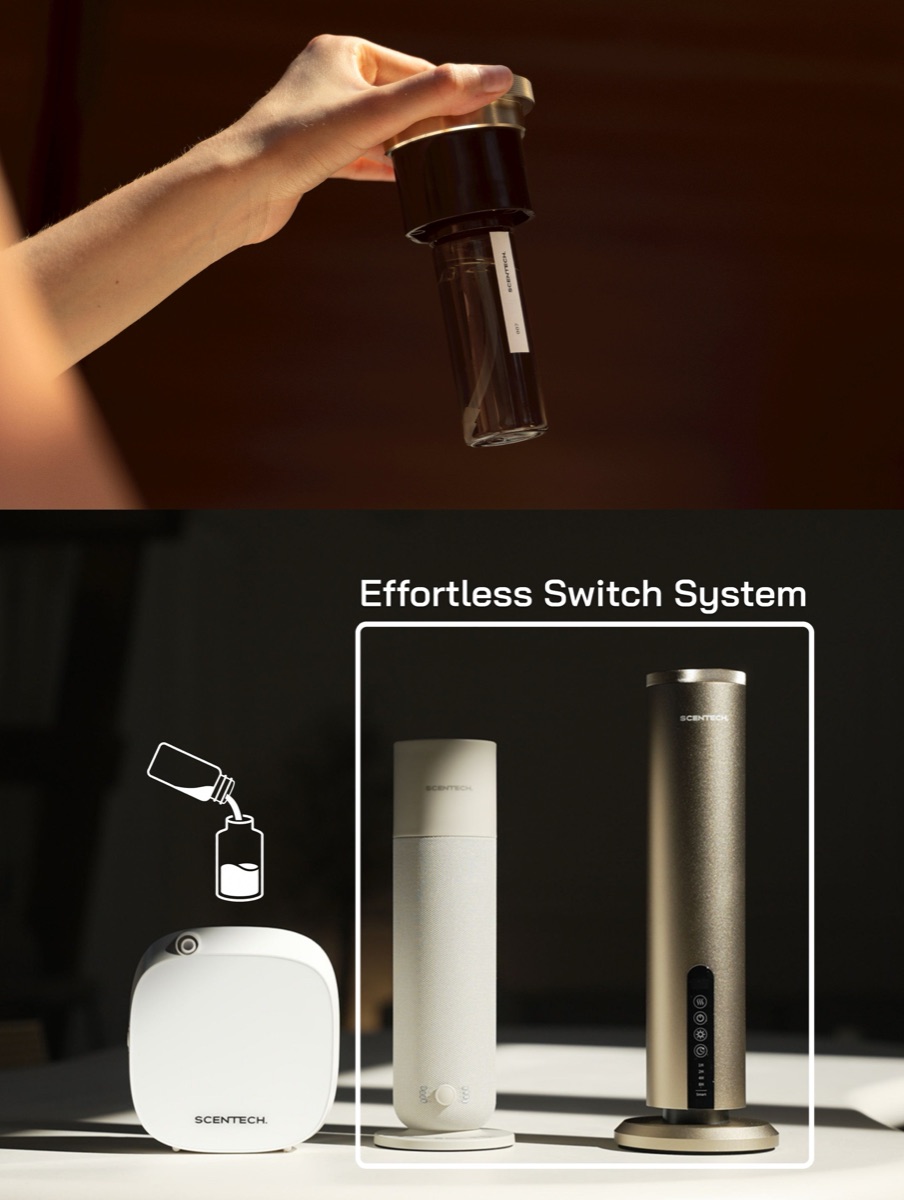
A waterless diffuser — Scentech calls its version cold-air diffusion — takes the fragrance oil as it comes and uses air pressure to shear it into a dry mist of very small droplets. There is no water to dilute it and no heat to change it. Nothing condenses on the windowsill, because nothing wet leaves the device.
The practical consequence is concentration. Scentech's three models state coverage of up to 40, 65 and 100 m² respectively on their specification tables. The only model in our comparison with a water tank that states a room size at all is the Beurer LA 40, at up to 20 m². Those numbers come from different companies with different definitions and no shared method, so treat them as claims rather than measurements — but the gap between 20 and 65 is not a rounding difference.
The trade-off is that a waterless device is fussier about what you put in it. Scentech's own English FAQ is blunt: "Never use water or oils meant for a water-based diffuser." Its diffusers take Scentech ScentPods and nothing else, and other oils fall outside the warranty. An ultrasonic diffuser, by contrast, will take whatever is in the cupboard.
Five differences you notice at home
1. Refilling, and how often
An ultrasonic diffuser is refilled by the fill. Tisserand states four to five hours of mist per 100 ml, so an evening. John Lewis states 45 minutes for both of its own models. That is a jug of water carried through from the kitchen every time you want the room to smell of something.
A waterless diffuser is refilled by the pod. Scentech states one to three months per 65 ml ScentPod depending on hours and setting, with a worked example of twelve hours a day on a medium setting lasting well over two months. The Diffuser 2 and the Pro take a pod that clicks into place; the smaller Smart Aroma Diffuser has to be decanted into a reservoir, which is one of the two genuine drawbacks we list against it.
2. Cleaning, limescale and standing water
Any tank of standing water in a warm room is a housekeeping job. The US Environmental Protection Agency, writing about home humidifiers, advises emptying and drying the tank daily, because ultrasonic and impeller devices can throw micro-organisms and dissolved minerals from the water into the air. An ultrasonic aroma diffuser works on exactly the same principle, so the same advice applies to it. In a hard-water part of the country you will also be descaling it.
A waterless diffuser has no tank, so there is nothing to empty, nothing to dry and no limescale. What it does have is a nozzle and a bottle, and it will not run on anything but its own oil.
3. Moisture in the room
An ultrasonic diffuser is a very small humidifier with a scent function. Between October and March, when the heating is on and the windows stay shut, some people want that and some emphatically do not, particularly in a flat that already shows condensation on the bedroom window in the morning. A waterless device adds no moisture at all. If the damp is the problem, this difference decides the purchase on its own.
4. Noise
Scentech publishes 59.5 dB for the Smart Aroma Diffuser and 39.5 dB for the Diffuser 2 and the Pro. None of the five water-based models in our comparison publishes a decibel figure at all — not John Lewis, not Beurer, not Tisserand, not Stoneglow, not HoMedics. That is not evidence that they are loud. It is evidence that you cannot find out before it arrives, which for a device destined for a bedside table is its own kind of answer.
5. What the scent costs
Here the comparison is genuinely awkward, because the two systems buy different things. A Scentech ScentPod is £27.00 for 65 ml, which is £0.42 a millilitre of ready-made fragrance oil. Single-note essential oils at Holland & Barrett run from £0.50 a millilitre (Miaroma lavender, 30 ml for £15.00) to £1.28 (Tisserand organic lavender, 9 ml for £11.50), and Tisserand's own diffuser oils are £12.00 a bottle on its shop.
But an ultrasonic device uses two or three drops per fill, so its oil lasts a very long time, while a waterless device consumes neat oil continuously. Comparing the per-millilitre figures alone would make the pod look cheap and would be misleading. No manufacturer here publishes consumption per hour for an ultrasonic diffuser, so the honest position is that its monthly oil cost cannot be calculated at all. The cost per month page sets out what can and cannot be worked out, with the arithmetic on show.
Where ultrasonic genuinely wins
Three things, and they are real. It is cheaper to buy: £39.99 to £55.00 for the water-based models in our comparison against about £101 to £193 for the Scentech range at September 2026 conversion rates. It takes any oil you like, which matters if you already own a shelf of them or you want a single note rather than a blend. And in a small room it is entirely sufficient — a bedroom or a home office is well inside the 20 m² the Beurer commits to.
There is also a category that fits neither box cleanly. The Stoneglow Modern Classics Perfume Mist Electric Diffuser takes a 15 ml bottle of oil that John Lewis states lasts up to ten weeks, but the retailer never says whether water is involved, so we do not claim it is one thing or the other. When a page will not tell you the mechanism, that itself is worth noting before you spend £65.
Which to buy for which room
For one small room, on a budget, where you already have oils and do not mind the water: an ultrasonic model, and look for a stated room size before anything else. For a whole floor, or a room where you want the thing running twelve hours a day without becoming a chore, or a home where extra winter moisture is unwelcome: waterless. For a bedroom, take the published decibel figure seriously, and be suspicious of a silence about it.
Our seven-model ranking works through the specific devices in each camp, with prices and review counts as they stood on 9 September 2026 — see our pick and the full comparison.